Helping kids understand big feelings through stories
Young children feel anger, worry, jealousy and disappointment long before they have the words for them. A toddler who throws a toy and a six-year-old who goes quiet before school are often saying the same thing: "I have a feeling and I do not know what to do with it." Stories are one of the gentlest ways to help.
Why stories help with feelings
When a character in a story feels angry or nervous, your child gets to watch the feeling from a safe distance. They see what the feeling looks like, what it does to the character's body, and what the character tries. That gives children language ("her tummy felt tight") and ideas ("he took three deep breaths") they can borrow later.
What a good feelings story includes
- A named feeling. The story says clearly whether the character is angry, worried, sad or jealous. Naming a feeling is the first step to managing it.
- The feeling shown in the body. Hot cheeks, a tight chest, a wobbly voice. Children recognize these signs.
- No shame. The character is not "bad" for feeling angry. The feeling is real. What matters is what the character does next.
- One small, doable tool. A slow breath, squeezing a pillow, asking for a hug, taking space. Keep it simple enough for a child to remember.
- A calm, hopeful ending. The feeling gets smaller, and the character feels understood.
How to read it together
Read slowly and pause at the feeling. You can ask, "Have you ever felt like that?" but do not push if your child does not want to answer. Often they will bring it up days later, on their own terms. Stories at bedtime work well because the day is over, everyone is calm, and your child is close to you.
Make it about your child
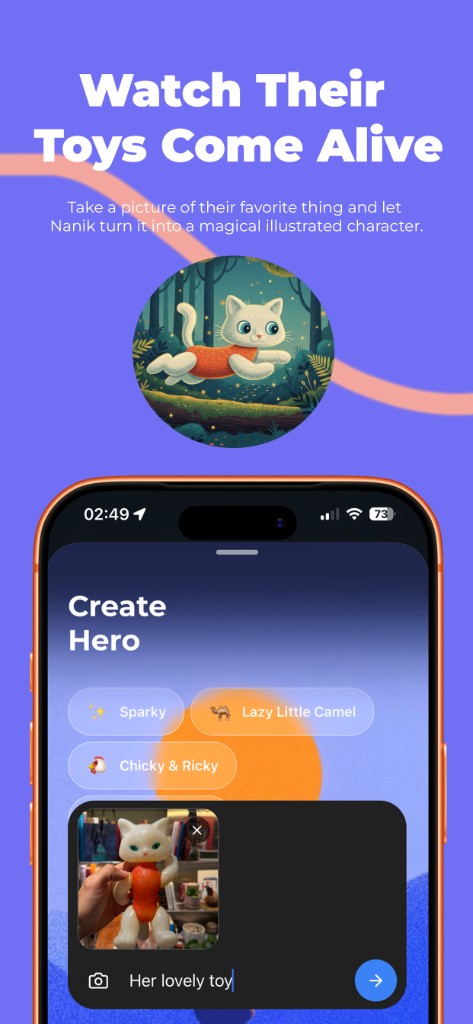
A story about a character who feels exactly what your child felt today lands much deeper than a general one. In Nanik you describe what happened ("she was upset when her friend would not share"), add your child's name and age, and get a short story with a gentle tool built in. You can choose a language, and have it narrated in your own voice. Try it in the box above.
Sample story: Tilly and the Thundercloud
Tilly was a little hedgehog who loved to build. Every afternoon she stacked pinecones into tall, wobbly towers in the garden.
One day, her tallest tower yet was almost finished. She had just one pinecone left to place on top when her little cousin Bo came running by, and whoosh! The whole tower tumbled down.
Tilly felt something rumble in her tummy. Her cheeks went hot. Her paws curled into little fists. And above her head, a small gray cloud appeared, no bigger than a pillow.
"That is my Thundercloud," Tilly thought. "It shows up when I am angry."
The cloud rumbled louder. Tilly wanted to shout. She wanted to stamp. For a moment, she wanted to knock down Bo's tower, too.
But then her grandmother, who had been watering the flowers, came and sat beside her. She did not say, "Do not be angry." She said, "That looked like a lot of work. I can see why you feel so upset."
Tilly's eyes felt wet. The cloud grew a little less heavy.
"Would you like to try something?" her grandmother asked. "Breathe in like you are smelling a flower. Then breathe out like you are blowing out a candle."
Tilly tried. In, like a flower. Out, like a candle. The Thundercloud rumbled, softer this time. In, like a flower. Out, like a candle. The gray turned to pale gray, then to white, and then it was just a fluffy little cloud floating away over the fence.
Bo came over, with big sorry eyes. "I did not mean to," he whispered. "Can I help you build it again?"
Tilly nodded. This time, they built the tower together, and it was even taller than before. When the last pinecone went on top, Tilly felt her tummy go warm and quiet.
That night, in bed, she told her grandmother, "My Thundercloud came, and it left again."
"Feelings are like weather," her grandmother said, tucking her in. "They come, and they pass."
Tilly smiled, breathed in like a flower, out like a candle, and drifted off to sleep.
The end.
Everyday ways to build on a feelings story
- Give the feeling a name your family uses, such as "the Thundercloud", and bring it up gently when it appears.
- Practice the breathing tool when your child is calm, not only when they are upset.
- Let your child retell the story to a toy or sibling. Retelling is a strong way to learn.
- Model it yourself: "I feel frustrated. I am going to take a slow breath."
When to get extra help
All children have strong feelings. If anger, worry or sadness is very intense, lasts for weeks, or gets in the way of school, friendships or sleep, talk to your child's doctor or a child psychologist. A story is a helpful everyday tool, but it is not a replacement for professional support.
Related: stories for bedtime fears · stories for new experiences · bedtime stories in your own voice